




Volume 02
A box doesn’t always do what the machine wants it to!
Where packaging quality truly begins.
Waste, complaints and machine stoppages are among the biggest cost drivers in packaging production. When a quality problem occurs, the search for a cause often focusses on places where it first becomes noticeable, such as in adhesive application, finishing or after delivery to the end customer. But a lot of defects actually occur much earlier. We spoke with an expert from Baumer hhs about why scoring quality often determines the economic success of a packaging process.

Stefan Hagemes is Business Development Manager Corrugated Board at Baumer hhs and has four years of experience with the company. Through his previous role in international sales and his current responsibility for the corrugated board segment, he has first hand knowledge of the industry’s requirements and developments. In close cooperation with customers, machine manufacturers and partners, he focuses on current challenges and future trends in corrugated board production.
Florian Lemke:When production managers talk about rising costs, they usually mention things like energy, personnel, and raw material prices. But waste, complaints and machine stoppages generate significant secondary costs. Do customers look in the wrong places for the source of such problems?
Stefan Hagemes: Yes, they do. We see it all the time, but it’s understandable. If a problem occurs on a packaging line, a box opens after gluing or complaints come in, your first impulse is to look at the step where the defect first became noticeable. You check gluing and the settings on the packaging machine, or examine the quality of the materials.
But in many cases, the real cause is much farther up the line. The quality and function of a packaging product is not determined by folding and gluing alone. It begins already with scoring. Scoring is the process of making a defined indentation in the material along what will be the fold line. It weakens the material along this line, allowing controlled, precision folding later on.
This step frequently receives less attention than others, which is surprising considering it has a major impact on how corrugated board behaves in downstream processes. If scoring is inadequate or not adapted to the product, boxes can be difficult to fold, glue flaps apt to reopen, or automated lines unable to reliably process the packaging. An added factor in the case of corrugated board is that, depending on the fluting, the score line can be on the crest of the flutes, in the trough, or on the area in between. As a result, the folding behaviour is not always entirely reproducible. This can lead to rejects and rework, or even machine stoppages or complaints from end customers.
In other words, from an economic standpoint, it pays to examine a process end-to-end, not just at one point where a problem first surfaces.
Florian Lemke:That may surprise a lot of readers. After all, scoring has been a standard step in corrugated production for decades. Why is it suddenly gaining more attention?
Stefan Hagemes: Because the basic conditions have changed considerably in recent years.
Packaging producers today are under tremendous economic pressure. Raw materials have to be used as efficiently as possible, packaging is designed to be more lightweight, recycled fibre content is on the rise, and brand-name manufacturers expect consistently high quality. Furthermore, regulatory requirements like the PPWR are forcing packaging producers to scrutinize material use, recyclability, and packaging concepts even more closely. Added to this are the production lines themselves, which are running at ever-faster speeds, meaning they have much tighter tolerances than they did just a few years ago.
Under these conditions, even minor deviations can have a significantly greater impact today than in the past. A box that could be processed easily ten years ago, can cause problems on a modern high-speed line. This is why attitudes towards scoring are changing. It is no longer viewed as merely a preparatory step, but as an important part of overall process quality.
Florian Lemke:In terms of process quality, do you mean that a functional packaging product basically starts even before the folder gluer?
Stefan Hagemes: That’s exactly right. It’s like building a house. If the foundation is off, problems that come up later on can only be corrected with a great deal of cost and effort. It’s the same with corrugated packaging. The quality of the final folded edge is influenced by the prep work for the fold line.
In simple terms, the process can be divided into three steps: The fold line is defined, the material prepared specifically for later folding, and the box blank finally folded and erected. If your preparations are precise, you can fold the material along the specified fold line in controlled fashion, reduce dimensional deviations, and guarantee that the box can be erected.
Many companies invest significant resources in optimizing downstream processes. But sometimes they overlook the fact that an improvement at the beginning of the process can prevent numerous problems.
Florian Lemke:Can you illustrate that with a practical example?
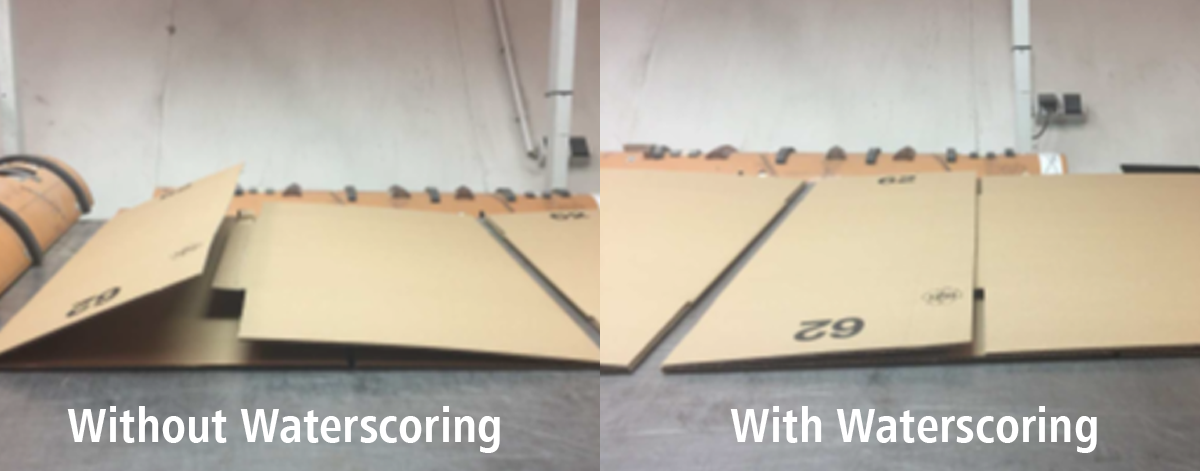
Stefan Hagemes: Take for instance a corrugated box that looks completely normal on the producer’s premises. It has been printed, die-cut, and released by the (in most cases) optical quality control system.
Once it gets to the end customer, the flat blank is automatically converted into a finished box and packed. The machine erects, fills and glues it. Suddenly, a problem appears: One of the side walls is slightly skewed, a flap is not in the right position, or the box cannot be fully erected. Possible consequences include disruptions in the material flow, machine stoppages and rejects. Stopping a machine can have far-reaching effects, particularly in the food industry, because it impacts downstream production and can generate high downtime costs.
For the corrugated board producer, the situation is difficult to understand at first because he can’t detect any obvious defects on the box blank itself. The real problem is how the material behaves later on during folding. If the spring-back forces are too high or the box was not glued squarely due to a non-parallel fold, then the box cannot be erected cleanly.
And this is the hidden danger: The error is not noticeable at first. It doesn’t become apparent until the moment when the box is actually erected.
Florian Lemke:So the box looks perfectly OK, even though the error has already occurred?
Stefan Hagemes: Correct. That’s what makes this issue so complex. A box can look completely acceptable and still have defects that don’t show up until later. Especially in automated processes, a slight deviation is all it takes and boxes can’t be processed.
While some can be processed without difficulty, others cause minor disruptions. Each individual interruption costs only a few seconds. But over an entire day or even year, these brief interruptions can add up to significant economic loss.
This is why we talk about process stability and reproducibility much more frequently today than we did a few years ago. Packaging manufacturers want above all to ensure that each and every box can be processed under identical conditions.
Florian Lemke:One term you mentioned is spring-back forces. That sounds like just a physical detail. Why is it so critical in practice?
Stefan Hagemes: Put simply, spring-back forces describe the tendency of a material to return to its original shape after deformation. It is an important material property of paper, paperboard and especially cardboard, because final packaging products have to be stable and retain their shape.
However, during the folding process, this characteristic can be a problem. If bending stiffness has not been sufficiently reduced along the score line, the material pulls against the intended direction of folding. Essentially, the box wants to open itself. The higher the spring-back forces, the more downstream processes are affected. Glue flaps are under tension, fold lines are not precise, and the reliability of the overall process is diminished.
A typical example is “pop-open”. This is when a glued seam comes undone after the folding process and before banding. But it is not gluing that causes pop-up. Instead, after folding, it is the spring-back forces of the material, pulling against the glued joint, that can cause it to pop open.
So it’s more than just a physical characteristic. Spring-back forces impact the entire process chain, from the first fold to the finished packaging delivered to the customer.
Florian Lemke:Has rising automation compounded these effects?
Stefan Hagemes: Yes, absolutely. Modern flexo folder gluers and multipoint gluers operate at tremendous speeds and have very tight tolerances. Problems a machine operator could compensate for before, usually cannot be corrected manually today.
Every single box blank has to function perfectly for these machines. Even minor differences in folding behaviour can interfere with the material flow.
For this reason, scoring quality is becoming much more important that it was ten or fifteen years ago. It has long since become more than just a minor detail of the production process; it is a key building block of cost-efficient and stable production flows.
Florian Lemke:You explained why spring-back forces are problematic. But how do operators actually notice them in day-to-day production?
Stefan Hagemes: Spring-back forces can have a variety of effects. Some are immediately evident, while others don’t emerge until finishing or final processing by the end customer.
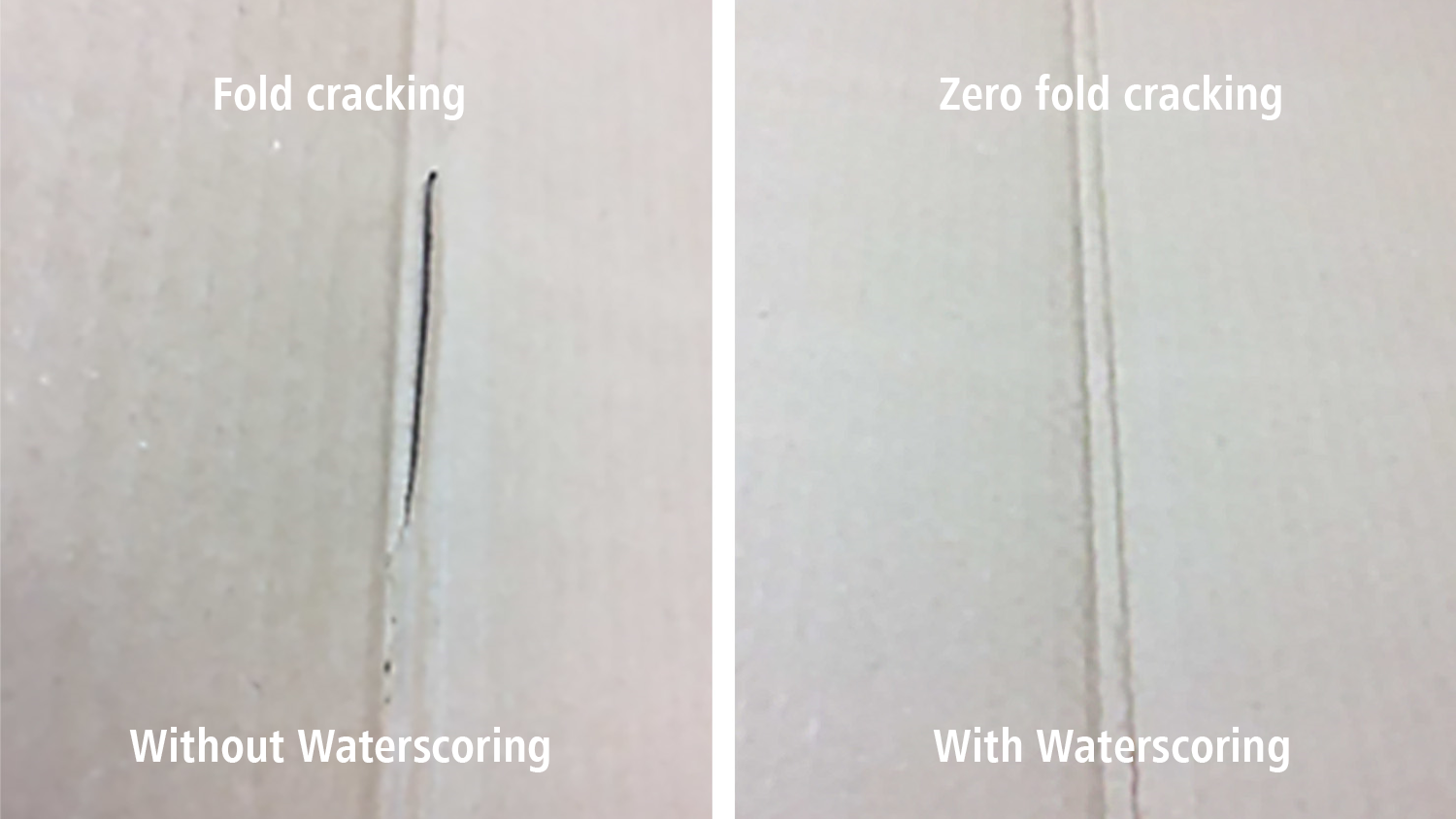
But there are other potential defects that are also common. One familiar example is score line cracking (fold cracking), which occurs when white stress breaks or fractures occur on the surface of the material along the fold line. Just think of premium corrugated boxes, whose appearance can be greatly impaired by this defect, to the point where the boxes no longer meet the quality standards of the brand owner.
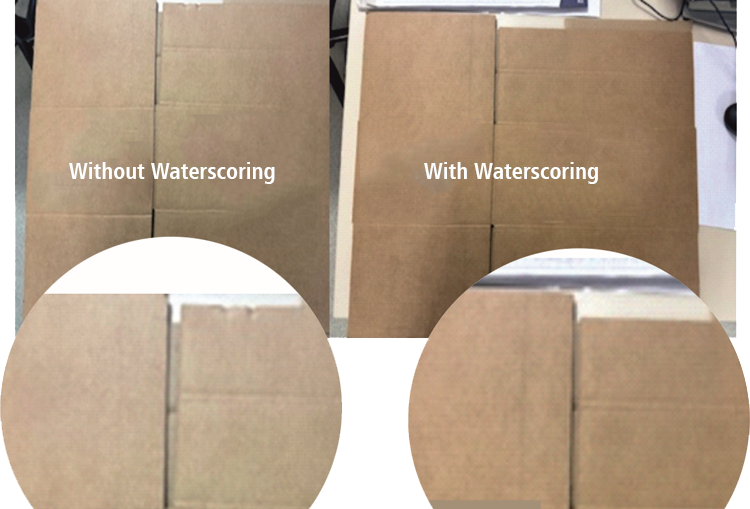
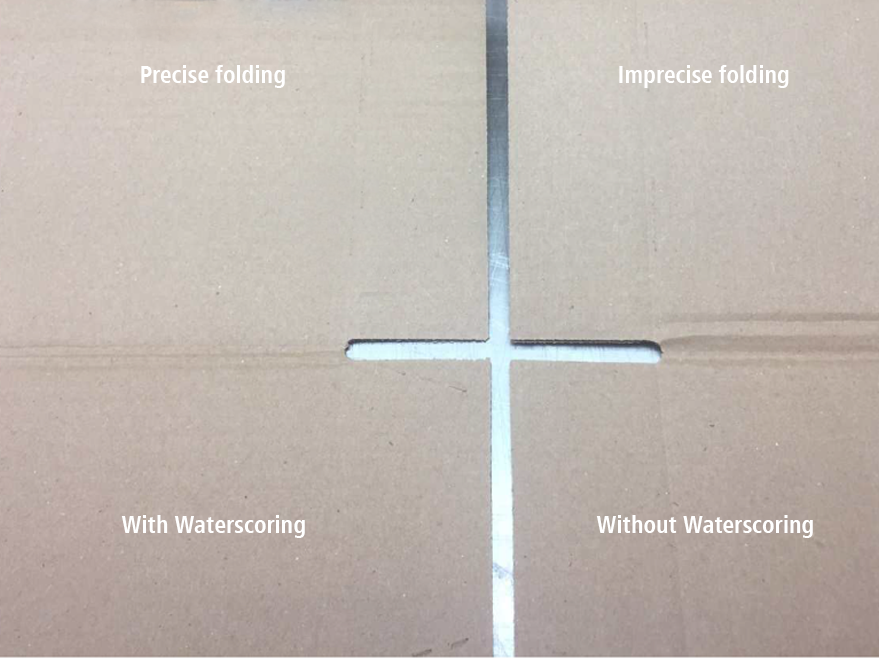
Another equally relevant effect is fishtailing. This term is virtually unknown outside the packaging industry; it describes a problem that has great impact on overall process reliability. Fishtailing is when the fold does not run exactly parallel to the pre-marked score line. The resulting folded edge is misaligned, flaps and edges no longer line up.
The result, particularly in the case of corrugated packaging: the boxes cannot be erected squarely, the glue flaps are under tension, or the boxes get jammed on the automated lines. What initially looks like an insignificant geometric deviation can cause rework, waste, or in the worst case scenario, costly stoppages in end-of-line packaging.
So we believe that score line cracking and fishtailing are far more than just isolated quality defects. Both make controlled folding of a given material impossible. The real challenge is not just to prevent visible defects, but to influence the material properties such that each box can be folded reproducibly along the specified score line.
Florian Lemke:Score line cracking and fishtailing both impact folding. Do they also have the same cause?
Stefan Hagemes: Not necessarily. Both problems can become noticeable during folding, but they occur for different reasons.
Score line cracking is due primarily to the material’s surface. For instance, if it is too dry, has the wrong grain direction, or scoring was too deep, the linerboard can rupture during folding. The structure and properties of the corrugated board can also influence how strongly the surface is stressed during folding. The deciding factor: the material is unable to adequately withstand the mechanical stresses.
In contrast, fishtailing relates the folding behaviour of a box blank. Imprecise score lines can cause folds to be misaligned, meaning they don’t follow the score line.
Because they are so different, these two defects should be examined separately.
Florian Lemke:Even though these two defects differ, they do have one common denominator: how the corrugated board behaves during folding. How can you specifically target folding behaviour?
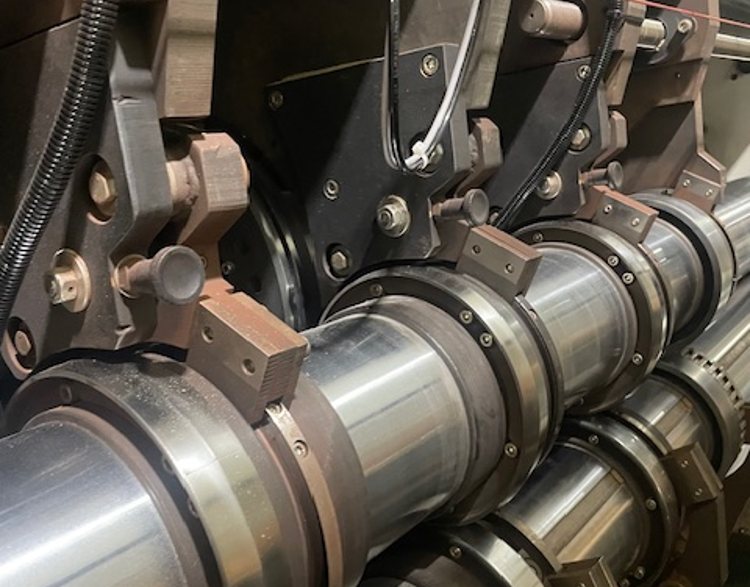
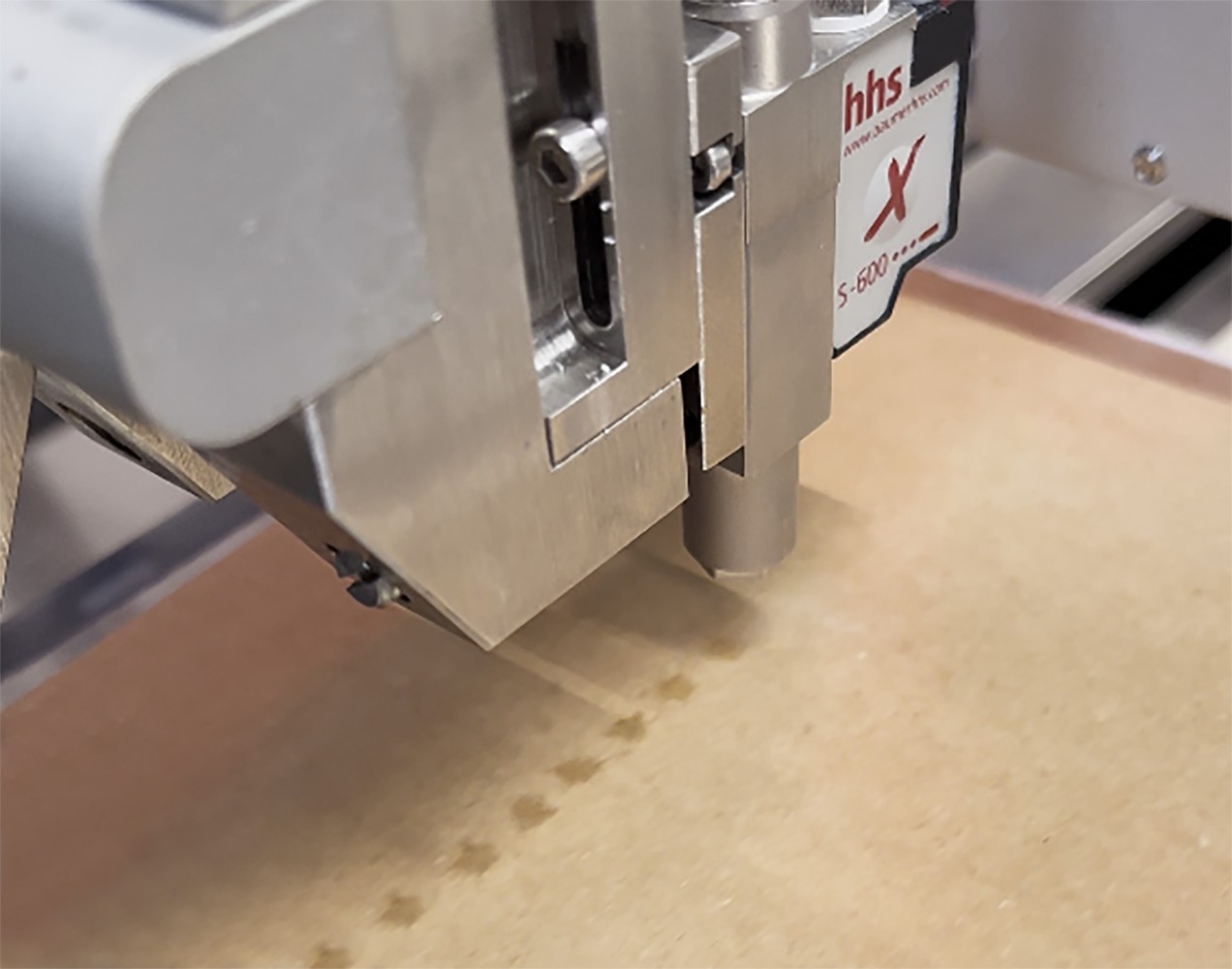
Stefan Hagemes: This is where waterscoring comes in. The basic principle is to favourably change the material properties along the fold line. Waterscoring involves the precision application of a special water-based folding fluid along the fold line to locally reduce bending stiffness while increasing elasticity.
The box blank can then be folded more easily along this line and the process is more controlled. Waterscoring can improve folding behaviour and mitigate the risk of fishtailing, particularly when processing against the flute direction.
It is important that dosing of the fluid is targeted and controlled. The purpose of waterscoring is not to simply weaken the material, but to influence its properties in those areas relevant to folding.
In other words, the objective is not to have just one solution for all potential defects, but to specifically improve conditions that promote controlled folding.
Florian Lemke:Waterscoring has been around for many years. Why is use of the technology spreading today, also among corrugated packaging producers?
Stefan Hagemes: The technology itself is by no means new. Waterscoring has been used successfully for many years to produce packaging inserts. But what is new, is its increased use for corrugated packaging.
Corrugated board has high bending stiffness due to its structure. It makes boxes stable, but precision folding difficult. Waterscoring can temporarily reduce bending stiffness along fold lines and increase elasticity.
It is generating a lot of interest, as demonstrated by the growth of Baumer hhs’s Easyfold waterscoring solution: Our company installed over 60 systems worldwide in the first six months of this year alone.
Florian Lemke:Has the use of waterscoring spread more among corrugated board or folding carton producers?
Stefan Hagemes: In fact, we are seeing growth in both segments. Corrugated board manufacturers are mainly concerned with subjects like fishtailing, spring-back forces, dimensional stability, and reliable erecting on high-speed lines.
Premium folding carton producers are more interested in visual design requirements. Score line cracking can be enough to cause packaging to no longer meet a brand owner’s quality requirements.
Be it corrugated board or paperboard, both of these applications ultimately pursue the same goal: The packaging must support reproducible folding and reliable finishing at all times.
Florian Lemke:What role does increasing recycled material content play?
Stefan Hagemes: A very big one, because recycled and virgin fibres behave differently. Packaging is also being designed to be more material-efficient. These two factors change the behaviour of the material during scoring and folding.
For packaging manufacturers, it means that processing windows are shrinking. Settings that worked perfectly before, can now lead to deviations with a different material. So a consistent process is gaining importance. Businesses want to achieve consistent results regardless of material fluctuations.
Florian Lemke:Can waterscoring alone offset material fluctuations?
Stefan Hagemes: By no means. It would not be correct to make that claim. Material properties will continue to fluctuate in future. But waterscoring can make them much more controllable. Our goal is not to undo the laws of physics. It is to lay the groundwork for a controlled and reproducible folding process. Because that is precisely what reduces fluctuations and makes processes more robust.
Florian Lemke:What kind of feedback have you been getting from customers?
Stefan Hagemes: Interestingly, our customers rarely mention individual defects to us, like score line cracking or fishtailing. We hear from corrugated packaging producers much more frequently, who describe more reliable workflows and greater overall process reliability.
These two effects have a direct impact on cost-efficiency. When a process runs reliably, it reduces waste and rework. Businesses can cut costs in their own production processes.
Another important aspect is customer complaints. When an end customer can’t process packaging products as planned, it’s not only complaints and rework that generate costs. Customer relations suffer as well. So a controlled folding process helps not only to avoid costs, but also to demonstrate quality and reliability to customers.
Florian Lemke:Many businesses are investing heavily in automation. What role does the quality of scoring play in this context?
Stefan Hagemes: It plays a critical role. The higher the degree of automation, the fewer the options for offsetting material fluctuations or quality deviations during ongoing production. Put simply, automated packaging lines expect every item to be identical. Even small differences in folding behaviour can disrupt the material flow and impact the productivity of the entire line.
Upstream steps are therefore becoming increasingly important. Precision scoring enables modern packaging lines to exploit their full potential.
Florian Lemke:What developments do you see in the packaging industry in the years to come?
Stefan Hagemes: I believe that process stability will become a leading competitive factor. We will see materials continue to change, the degree of automation rise, and the demands on quality, resource efficiency and cost-efficiency grow.
In response, businesses will invest more in technologies that stabilise processes and reduce fluctuations. It will become critical not only to optimise individual machines, but to reliably coordinate the entire process chain. The earlier you can identify and eliminate sources of error, the stronger your foundation for a cost-efficient and future-proof production process.
Florian Lemke:If you could give our readers one piece of advice as a takeaway, what would it be?
Stefan Hagemes: Quality problems often don’t become noticeable until they are already generating costs.
So it pays to keep an eye on the whole process.
By treating scoring not merely as a preparatory step, but as a critical part of overall process quality, you pave the way for stable production flows, less waste and fewer complaints.
Keep in mind though that waterscoring is not an end in itself. The technology helps to locally reduce spring-back forces, stabilise folding processes, and achieve consistent results. But it’s the economic benefit that counts. Every interruption you avoid, all rework you eliminate, and every reject you prevent helps to cut costs in production long-term. So in many cases, the most cost-efficient solution begins long before the first box is folded or glued.
Florian Lemke:Thanks for the interview!