




Volume 01
There’s no such thing as standard gluing
Why packaging manufacturers reduce adhesive consumption not by using less adhesive, but by optimising its application.
In response to rising material costs, stricter quality demands and the economic necessity of optimising production processes, packaging manufacturers are increasingly focussing on adhesive application. But does it offer any real options for cuttings costs? And where do modern application technologies come into play? We spoke with Gustavo Cuata to find out why using the smallest amount of glue isn’t the objective, why there is no such thing as standard gluing, and why cost-efficient optimisation means taking a look at the entire process.

Information: Gustavo Cuata, head of Global Sales at Baumer hhs, has over 25 years of international experience in the automotive, packaging and automation industries. With his technical expertise and years of experience in international sales, he has a unique ability to bridge the gap between market demands and the practical challenges encountered in production. He specialises in cost-efficient solutions for industrial gluing and quality control in the packaging industry.
Florian Lemke: Mr. Cuata, do packaging manufacturers know how much adhesive they really use?
Gustavo Cuata: In many cases, they don’t know the exact numbers, although they do know of course how much they’ve been purchasing. But purchase costs don’t help to determine precisely how much glue was used for which products or production orders. Adhesives are often viewed as consumables, meaning they are simply re-ordered as soon as stocks start to run out. Most businesses do not systematically analyse actual consumption.
But they should, because it can really pay off. Knowing your adhesive consumption gives you the information you need to target specific cost-cutting potentials and make sound decisions.
Florian Lemke: Why is this topic getting more attention now than it did a few years ago?
Gustavo Cuata: The demands on packaging manufacturers have changed.
Today they have to design production processes to be more cost-efficient and use resources more efficiently, all while guaranteeing consistently high product quality. In this environment, adhesive application also becomes more important. At high production volumes, even small changes can add up to significant differences in consumption over a period of one year.
Businesses today should therefore view the adhesive not as just a consumable, but as a critical process parameter that can be optimised.
Florian Lemke: Do you mean they should generally apply as little glue as possible?
Gustavo Cuata: No, not at all. That would be precisely the wrong approach. Stable glued joints are always top priority, because damage to a packaged product due to faulty gluing ultimately generates much higher costs. So the goal is not to reduce glue use to a minimum, but to optimally adapt it to the given application.
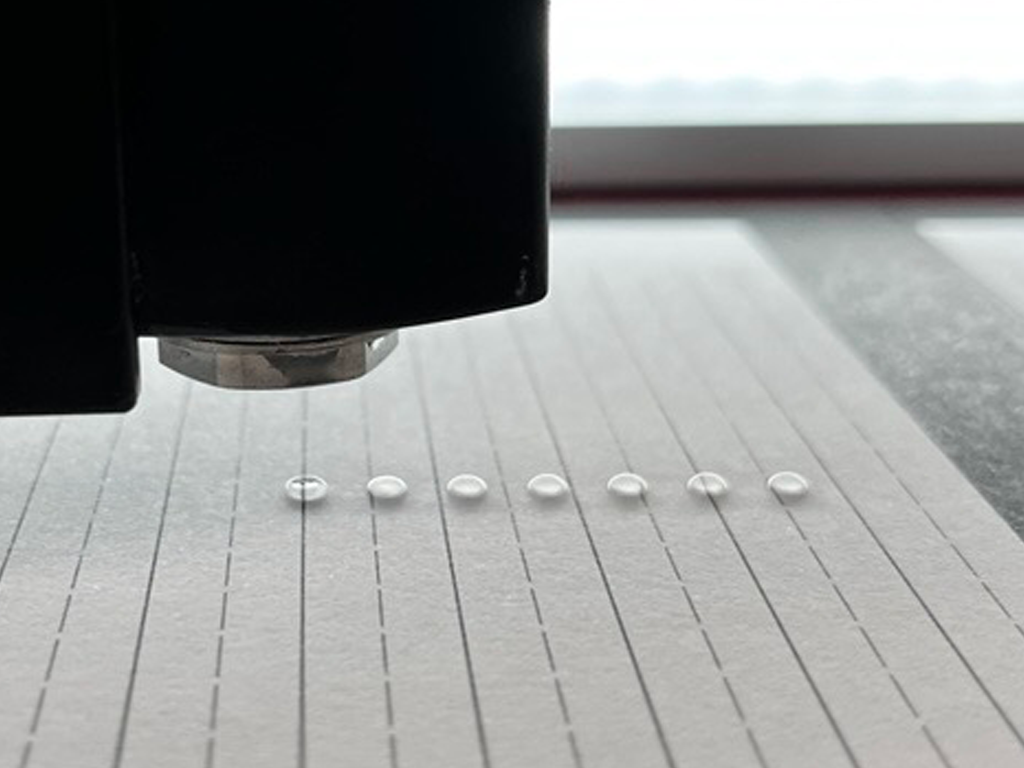
There’s no such thing as standard gluing. What’s important is to optimise gluing to suit the application.
Once you’ve done so, adhesive use can be reduced without compromising overall process reliability or the quality of glued joints.
Florian Lemke: What does optimal adhesive application depend on?
Gustavo Cuata: There are a number of parameters, including packaging design, the properties of the packaging material, the adhesive, the production speed, and the position of adhesive application.
Every product has its own set of requirements, so there is no single setting that can be used for all production processes.
Optimal adhesive application always results from the interplay of these parameters.
Florian Lemke: What options exist for reducing glue consumption without compromising glued joints?
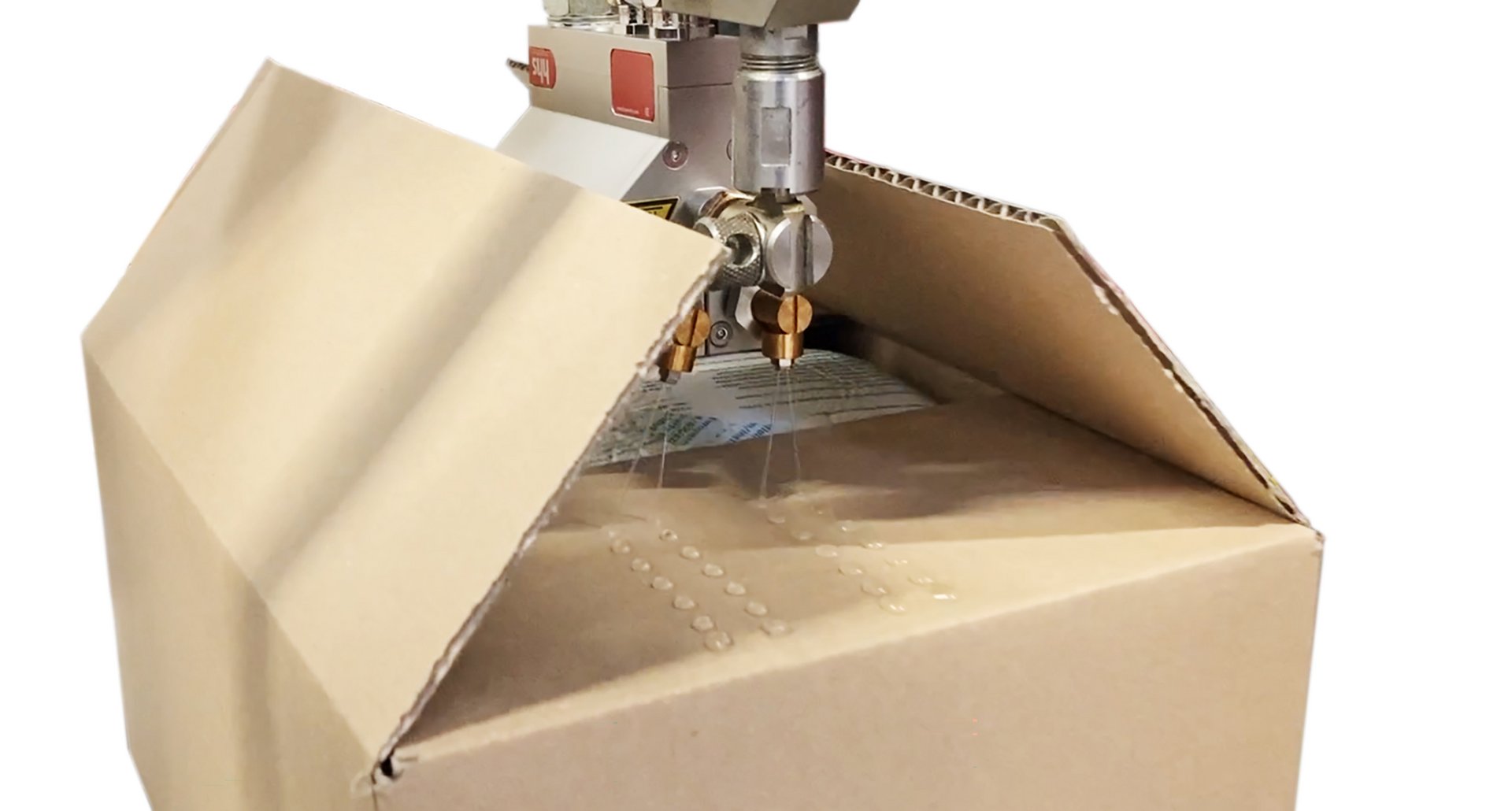
Gustavo Cuata: Dotting and stitching are among the leading application methods today.
They involve the targeted application of individual points or short segments of glue. Both methods pursue the same goal: to apply glue only where needed to achieve a strong bond.
They can be used reliably today in industrial production processes thanks to the development of advanced gluing equipment.
High-precision application systems make it possible for the first time to reproducibly apply individual dots or stitches and take full advantage of the potential savings on adhesive.
Developing valve technologies of this kind has been one of Baumer hhs’s core competencies for many years.
Florian Lemke: What advantages does this equipment give packaging manufacturers?
Gustavo Cuata: The greatest advantage is that they can start using optimised adhesive application in production right away, without investing a lot of time and effort.
How much manufacturers can save with the new set-up depends on the application. Let me give you an example from end-of-line packaging to illustrate.
Assume we have a wrap-around cartoner with five applicators and a production output of 3,600 units per hour. The total bead length is 1.1 metres. The adhesive is applied to four bottom flaps of ten centimetres each, four top flaps of ten centimetres each, and one side seam of 30 centimetres in length. The bead width before compression is 2.5 millimetres.
Under these conditions, adhesive consumption is about 9.9 kilograms per hour. In two-shift operation with 16 production hours per day, a five-day week and 4,000 production hours per year, this results in annual adhesive consumption of 39,600 kilograms.
In this example, dot application can cut adhesive consumption by 50 percent, equivalent to a reduction of 19,800 kilograms per year.
Based on the price of their adhesive, packaging manufacturers can easily calculate how much they would save in this scenario.
Florian Lemke: That’s much more than I would have expected! This example shows just how high the potential savings are, even on a single packaging line.
Gustavo Cuata: It goes without saying that lowering consumption directly impacts costs. But other effects also become apparent in day-to-day production. Production runs more smoothly, less effort is required for cleaning, and unplanned interventions in production become less frequent.
Which of these effects is more pronounced in individual cases depends on the specific application. But in my experience, the economic benefits very often go beyond the savings on adhesive.
Florian Lemke: So once you’ve defined the gluing parameters for an application, are you all done?
Gustavo Cuata: It’s an important milestone, but not the actual goal.
What is critical is adhering to the defined parameters from then on, because that’s the only way to keep benefiting in the long term from the improvements achieved.
Florian Lemke: Is quality monitoring the logical next step for optimised adhesive application?
Gustavo Cuata: It certainly is, in my opinion. The job of the gluing equipment is to reproducibly apply the prescribed amount of glue in the right position. Quality monitoring supports this by continuously checking whether these defined application settings are maintained in ongoing production.
These two areas combined are the foundation for consistent results.
It is also why Baumer hhs for many years has been developing both adhesive application technologies and quality monitoring solutions. Our objective is to help packaging manufacturers to consistently and reliably adhere to defined parameters for adhesive application.
But how advanced quality control systems work and how they contribute to process reliability is a subject in its own right, which we could cover separately.
Florian Lemke: How does this trend impact Baumer hhs and its activities?
Gustavo Cuata: Our customers do not invest in individual components. They want integrated system solutions that make their production processes run reliably and cost-efficiently.
So we think in terms of solutions, not individual components.
Florian Lemke: How does this approach differ from classical product-focussed business?
Gustavo Cuata: Individual components fulfil a specific task. But in day-to-day production, it’s not the performance of a single component that determines success; it’s the interplay of all participating technologies.
For this reason, we always analyse tasks in their overall context. We want to help packaging manufacturers find solutions that prove effective in the long term, under real production conditions.
Florian Lemke: Where do you see the greatest improvement potentials for packaging manufacturers today?
Gustavo Cuata: Often in processes that have gone virtually unchanged for many years.
A setting that was ideal a few years ago may not necessarily be the best solution today. Products develop, production speeds change and the requirements for packaging change too.
So it pays to regularly review existing settings and adapt them as necessary to changed requirements.
Florian Lemke: Are optimisations like the ones you describe always associated with a lot of time and effort?
Gustavo Cuata: By no means. Today’s gluing systems have greatly simplified things.
A good example is the Easy Teach-In feature used in various solutions from Baumer hhs like the CorrBox Solution. All users have to do during job changeovers is press the Wizard button. The system automatically detects and adopts the required settings. The operator no longer needs to manually enter positions or glue patterns.
As a result, format changes can be made quickly and reproducibly. Adhesive application can be adapted to new production requirements without a lot of extra work, making it much easier to consistently exploit potentials for optimisation in daily production.
Florian Lemke: Have packaging manufacturers today changed their view of adhesive application?
Gustavo Cuata: I think they take a much closer look at how their production processes actually function.
In the past, the main question was whether a packaging product needed to be sealed. Today, manufacturers additionally strive to make processes more cost-efficient, better understand consumption, systematically exploit optimisation potentials and reduce production costs.
And I heartily welcome this trend because improvements rarely come about by accident. They usually start with a critical analysis of existing workflows.
Florian Lemke: So optimisation is not just a one-time project?
Gustavo Cuata: Exactly. Optimisation is not a static state, but a continuous process. If you regularly review your production process and put the findings to good use, you can lay the groundwork for sustainable improvements.
Keep in mind, however, that it’s not about constantly changing everything. It’s about identifying new developments early on and adapting adhesive application to any changed requirements.
Florian Lemke: What advice would you give a production manager who believes he can’t find any more optimisation potentials in his process?
Gustavo Cuata: I would advise him to keep analysing the process, but from a different angle.
In day-to-day production, we get so used to many of the workflows that we often fail to see improvement potentials unless we deliberately question existing settings.
In my experience, looking at your process through a different lens pays off virtually every time. Not because a setting is wrong, but because basic conditions change over time.
Florian Lemke: What are your main takeaways for readers?
Gustavo Cuata: I believe that focussing on adhesive application is the right way to go.
Not because you should use as little adhesive as possible, but because optimised gluing can contribute greatly to a cost-efficient and stable production process.
There’s no such thing as standard gluing. What’s important is to always optimise gluing to suit the application.
Florian Lemke: Mr. Cuata, thanks for your insight.